Invest simply

Adapted for US readers from five Swedish RikaTillsammans pages. Items marked US review depend on US tax rules, US products or US numbers and need a check before publishing. This is education, not personalized advice. All investing carries risk: values go up and down, there are no guarantees, and in the worst case you can lose what you put in.
Investing well is simpler than the financial industry wants you to believe. Much of that industry earns its living from making saving look complicated. What follows is the short version of what the research points to, how to act on it in the US, and how to avoid the mistakes that cost people the most.
The research based way in one paragraph
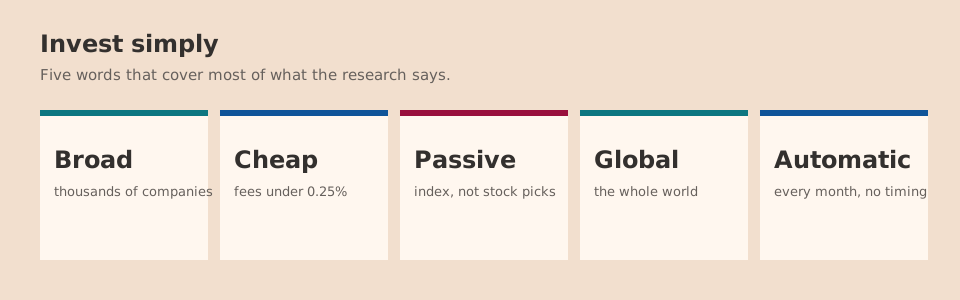
Save regularly, automatically and for the long term in a broad, cheap, passive, global stock index fund, or in an all in one service that does the same thing for you. Match the risk to your time horizon: money you need soon stays in the bank, money you will not touch for a decade or more gets invested. Then do the hardest part, which is nothing. We call it the boring method, and boring is the point.
Everything below explains one of those words.
Why invest at all?
Nobody has to. The most useful first question is "why do I want to invest?" For most of us the honest answer is freedom: working less, traveling more, more time with family, a cushion that lets us say no. Money is stored freedom, and it buys back the one thing we cannot make more of, our time. To see how it grows, try the compound growth calculator on our tools page. If what you want is excitement, keep that to a small slice of fun money and keep the rest boring.
Two camps: active and passive
Picture yourself at a harbor centuries ago with a handful of coins and many ships about to sail. You have two choices.
- Active: interview the captains, study the ships and try to back the winners while avoiding the ones that sink.
- Passive: admit that nobody can reliably predict which ship meets a storm, and spread your coins across all of them.
The financial industry mostly lives in the active camp, because that is where the fees are. The research mostly favors the passive camp. Three strands of it are worth knowing.
- The theory. Nobel Prize winning economists argued decades ago that, taken together, active investors must earn less than the market after costs, and that any step away from owning the whole market adds risk you are not paid for. US review
- The scorecard. S&P Dow Jones Indices publishes a regular report called SPIVA that compares active funds with their index. In its twenty year summary the conclusions were that most active managers underperform their index, that past outperformance does not predict future outperformance, and that the gap tends to widen the longer you measure. We cannot quote exact percentages here without checking the latest edition. US review
- The haystack. Research on US stocks from 1926 to 2016 found that a little over 4% of all stocks (1,092 of 25,967) accounted for the entire gain of the market above the return on safe Treasury bills, and that most individual stocks did worse than those bills. Own the whole haystack and you are certain to hold the few big winners. Own fifty stocks and you may well miss them. US review
The Swedish site summarizes the evidence as more than nine in ten professional active funds losing to a simple index fund over ten years. That figure draws on Swedish and global data, so check the current US SPIVA numbers before using it. US review
An index fund will never be a "winner fund", because by definition it earns the market average. The trick is not to win the game but to avoid losing it. Staying average, cheaply and for decades, tends to put you ahead of most investors.
Risk and time horizon
Risk is the entrance fee for returns. Your portfolio will rise and fall from the first day you invest. The worst case, losing everything, is close to theoretical with a diversified fund holding thousands of companies, because it would take the world's largest businesses failing at the same moment. Single stocks are a different story.
Risk is more than one thing
We find it helps to split risk into five kinds.
- Everyday risk: the car breaks down, the job disappears. Handle it with an emergency fund and insurance.
- Life risk: the money does not stretch to the life you want. This is the real risk most of us are saving against.
- Inflation risk: cash in the bank quietly buys less each year. Avoiding investment risk means accepting this one instead. You cannot avoid risk, only swap one kind for another.
- Investment risk: prices swing. The market pays you for carrying this one, so we accept it.
- Behavior risk: you. Panic selling, chasing last year's winners and tinkering are among the most expensive risks of all.
Some risks you can remove for free: company specific risk shrinks when you own thousands of companies. The skill is taking the right amount of risk for your goals and time horizon.
Time is your best friend
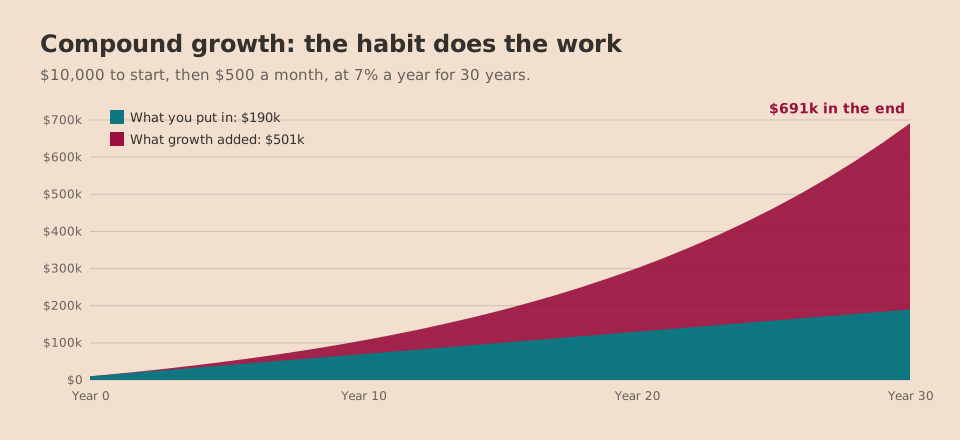
On any single day the market is close to a coin flip. As the months and years pile up, the odds of ending ahead rise and the range of outcomes narrows. Our rule of thumb:
| Money you need | Where it belongs |
|---|---|
| Within 0 to 3 years | An FDIC insured savings account or similar. Do not invest it. |
| In 4 to 9 years, or "not sure" | A mix, for example half in the bank and half in index funds. |
| In 10 or more years | Broad global index funds. |
Markets can fall hard and fast. In the 2020 pandemic crash, stock values dropped about 30% in roughly 30 days. An emergency fund is what lets you sit still through a storm like that instead of selling at the bottom. Your daily life should never suffer because of your investing.
Match risk to your stage of life
At 25 your biggest asset is your future earning power, so a high stock allocation makes sense. At 65 the savings have to last decades, so flexibility becomes worth more than a higher expected return.
Flexibility beats prediction
You cannot forecast, but you can build flexibility: expenses you can trim, the option to work a year longer, the right insurance and a cash cushion. The more flexibility you have, the more investment risk you can comfortably carry. A good exercise is to ask "what is the most dangerous thing in our finances right now?" and fix that first. For most people it is a missing emergency fund or insurance, not the choice of fund.
For the bigger picture of how time horizons fit together, see our framework on the money path page, which describes the Runway, Bridge and Engine horizons and a step order.
How to get started in the US
Whatever the amount, the method is the same. The amount only changes how much the details are worth. Work through the accounts in this order. US review
- Capture the full 401(k) match. If your employer matches contributions, contribute at least enough to get all of it. It is an instant return no fund can beat. Pick a broad index fund or a target date fund inside the plan.
- Pay off high interest debt. Credit card balances and similar debt cost more than investing can reliably earn. Clear them before investing beyond the match.
- Build an emergency fund. The classic guidance is three to six months of expenses, and more if you have children, a single income, variable pay or a home to maintain. Keep it in an FDIC insured savings account. See the FAQ for how to size it.
- Fund an HSA, if you are eligible. A health savings account requires a qualifying high deductible health plan. If you qualify, it has a rare triple tax advantage and can double as a long term account. Contribute up to the annual IRS limit. US review
- Fund a Roth IRA. Contribute up to the annual IRS limit, subject to income rules. Some higher earners use a different route, so check your eligibility. US review
- Go back to the 401(k). Raise your contribution toward the annual IRS limit for the plan.
- Invest in a taxable brokerage account. Once the tax advantaged accounts are full, this account has no contribution limit. Holding broad index funds keeps it simple and tax efficient. US review
Then:
- Choose the fund using the next section. Most major brokerages offer the types we describe.
- Automate the contribution so that money moves on payday without a decision. This is the single most useful habit. If you are new, start with a small amount today. You can raise it later.
- Lump sum or monthly? If you already have a lump sum, the math says invest it all at once, since money invested longer has more time to grow. The emotions say spread it out. Our compromise is the 50/50 rule: invest half now and the rest on a fixed schedule over the coming months.
- Then stop checking. The hard part is not buying the fund but leaving it alone for years.
How to choose a fund
Most people choose funds badly, and often for reasons that sound reasonable. The two most common methods are looking at star ratings and looking at recent performance. Both are close to useless, and the industry has a financial interest in keeping them popular, because they help sell expensive funds. Three facts worth knowing, as the Swedish site states them. US review
- Past returns say little about future returns. One cited study found that few funds in the top half stayed there five years later.
- Star ratings do not predict the future. A three star fund has been found to have better odds than a five star one.
- Active funds lose to index funds over time. See the research above.
What to do instead
Pick a fund that passes three tests.
- Broad. It should hold as many companies as possible. Two common fund types do this: a total world stock fund, which holds companies from all over the world in one fund, or a total US stock fund paired with a total international stock fund, which gives the same coverage in two pieces and lets you choose the split.
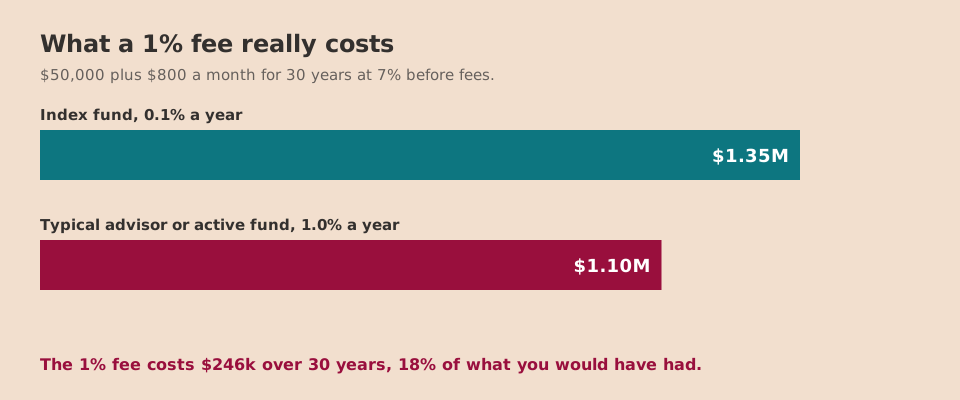
- Cheap. The fee should be as low as you can find. Every dollar you do not pay to the industry stays in your pocket and keeps compounding. The expense ratio has one of the strongest links with good long term results of anything you can look at. Broad index funds from large US providers typically cost well under 0.2% a year, so aim for that range. US review
- Passive. The fund tracks an index rather than trying to pick winners. In the fund name, look for words like "index", "total market" or "total world".
Compare the three tests above on the fund's fact sheet, not a ticker someone recommended. Two index funds that pass all three are a coin flip on which does better, so pick one and move on. Our studies page collects the research.
Also check where the fund sits. Inside an IRA or 401(k) you can switch without tax consequences. In a taxable account, selling can trigger capital gains tax, so be careful before replacing old holdings. US review
Robo advisor or index fund?
Once you have decided to follow the research, one question remains: do it yourself with an index fund, or hand it to a robo advisor? Our community splits on it, and it matters much less than it feels. Either way you will probably end up ahead of most investors.
The case for doing it yourself
- Lower cost. A single index fund is typically cheaper than a robo advisor's fee on top of its underlying funds. The gap is small, though, and when you compare like with like (a robo portfolio also holds small companies and emerging markets) it shrinks further.
- Control. You pick exactly what you hold and where you hold it, and you can use the brokerage you already trust.
- Flexibility. Some brokerage features, such as borrowing against your holdings, are not offered by every robo advisor. US review
The risks: it is easy to open an account and never finish, chase last year's winner, forget to rebalance or tinker.
The case for a robo advisor
- Easy to get right. The sign up questions walk you through account type, mix and goals, like advice in checklist form. It is hard to end up with a bad portfolio if you follow the process.
- Broader mix. Many hold thousands of stocks across the world, plus bonds, in one portfolio.
- Automatic rebalancing. When markets move, the service brings you back to your target mix, for example 90% stocks and 10% bonds.
- Less of the gap. Morningstar's "Mind the Gap" reports have shown that investors on average earn less than the funds they own, because of badly timed buying and selling. Automatic solutions shrink that gap. US review
The downsides: a slightly higher fee, portfolio choices you may not agree with, and in some cases fewer tax features than a regular brokerage. US review
Which one should you choose?
If you are someone who hunts for the last basis point of savings, you will prefer an index fund. If you tend to optimize the whole picture and want fewer decisions, a robo advisor may fit you better. A difference of about 0.1% on $100,000 is $100 a year, which is small next to the cost of one behavior mistake. Pick whichever one you will actually use. If you cannot decide, do both. A target date fund in your 401(k) is another simple middle path. US review
Why doesn't everyone do this?
Because investing is counterintuitive. In most of life the person who does the most wins. In investing the better odds go to the one who is patient, passive and rarely logged in. As one of the world's most successful investors put it, nobody wants to get rich slowly.
The short version
- Save and invest regularly, automatically and for the long term in a broad, cheap, passive, global index fund, or a robo advisor that does the same.
- Match the risk to your time horizon: bank for 0 to 3 years, a mix for 4 to 9, index funds for 10 or more.
- Have an emergency fund first, use your tax advantaged accounts in order, then be lazy. Keep buying. Go and do something else.
Still have questions? See the FAQ, run the numbers on the tools page, or come and talk to us on the community page.