The Wealth Ladder

Adapted for US readers from the Swedish RikaTillsammans "Rikedomstrappan" pages. The Swedish version converted a US model into kronor and adjusted it to Swedish life, so for this page we went back to dollars and to US circumstances. Items marked US review need a fact check before publishing. This is education, not personalized advice.
Why a ladder?
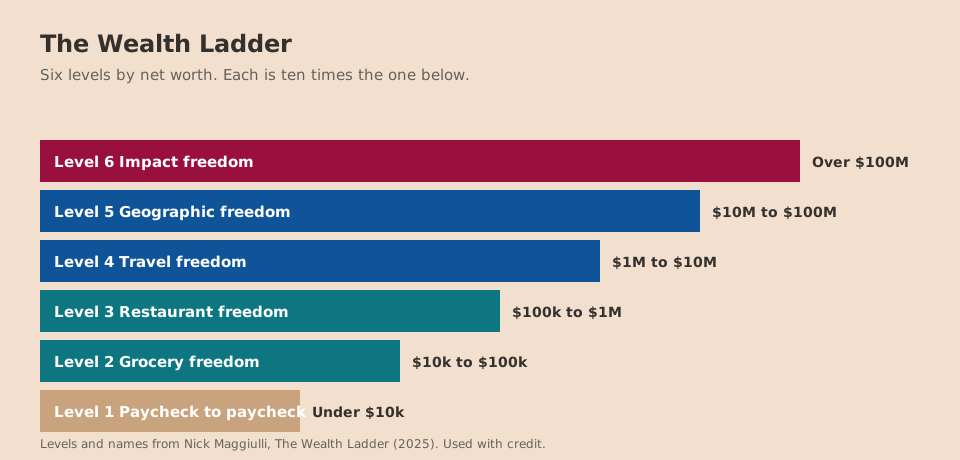
Different amounts of money call for different strategies. A tip that fits someone with $2,500 in the bank can be irrelevant to someone with $250,000 and harmful to someone with $2.5 million.
The Wealth Ladder is a map with six levels, based on your household's net worth: everything you own minus everything you owe. Each level is roughly a tenfold jump from the one before. The model and the level names come from Nick Maggiulli's 2025 book The Wealth Ladder, which we recommend reading in full. On the lower rungs the questions are practical (how do I save, pay down debt or invest?) and bad luck can matter enormously. On the higher rungs the questions become personal: should I keep working, and how do I raise grounded kids when money is not a worry?
Some things to know first: it is a map, not a grade, and higher is not better. Level 3 is where, by most reasonable measures, you have won the game, and climbing past level 4 often brings mostly downsides. Net worth is tied to age, so the same number means something different at 25 and at 65.
Work out your level
Add up what you own (home equity, retirement accounts, brokerage and bank accounts) and subtract what you owe (mortgage, student loans, auto loans, credit cards). A rough estimate is enough, and our tools page has calculators.
| Level | Net worth | Short name |
|---|---|---|
| 1 | Under $10,000 | Paycheck to paycheck |
| 2 | $10,000 to $100,000 | Grocery freedom |
| 3 | $100,000 to $1 million | Restaurant freedom |
| 4 | $1 million to $10 million | Travel freedom |
| 5 | $10 million to $100 million | Geographic freedom |
| 6 | Over $100 million | Impact freedom |
The short names are our adaptation of the original model's labels and need checking against the book. US review
Level 1: Paycheck to paycheck (under $10,000)
What life feels like. Most of us start here. Savings are small or nonexistent, and there can be many days left in the month when the paycheck runs out. Financial stress is common. Money is something you survive rather than something you use.
The main risks. Bad luck. A car repair, a medical bill, a lost shift or an illness can start a downward spiral, especially if you have no cushion and can only borrow at high rates. In the US, where health costs and insurance are often tied to a job, this hits hard. US review
What to focus on. Build an emergency fund so you can sleep at night, and work toward the first $10,000 of net worth. The lever with the most effect is usually income, not squeezing already small expenses: an extra job or shifts, a skill that pays more, a better employer. Ask for help from family, friends and community. See the money path page for the order of steps.
The most common mistake. Trying to fix everything by cutting spending further when the real problem is the income side, or taking on high interest debt to cover the gap.
This level is temporary for people who actively work on it, and most move on.
Level 2: Grocery freedom ($10,000 to $100,000)
What life feels like. You can usually sleep through the night without worrying whether the money will last until the next paycheck. You can buy what you need at the grocery store without checking every price tag. There is a cushion for ordinary surprises. Money in still roughly equals money out, but there is some slack.
The main risks. Lifestyle inflation, meaning spending that grows as fast as income does. A big expensive car or an oversized housing payment, which can keep you on this rung for years. Getting stuck in a job with no path to a raise. A car breakdown or a layoff is a setback here rather than a catastrophe.
What to focus on. Work smarter, not harder. Level 1 is about any job and more hours. Level 2 is about getting paid more for each hour: negotiating, switching employers, learning skills you can be paid for across a career. Income has the strongest link with wealth, and it also drives your retirement savings, unemployment and disability benefits and everything you can set aside. Our rule of thumb for the cushion here is one to three months of expenses, which is enough to change jobs without panic. US review Save toward a down payment if you want to buy a home, start investing in a broad index fund (see Invest simply), and watch the two big cost drivers, housing and cars. You can always buy the car later.
The most common mistake. Letting spending rise with every raise, and buying a car or house that costs so much it delays everything else.
Level 3: Restaurant freedom ($100,000 to $1 million)
What life feels like. Congratulations: you have a stable financial life. This is the rung many Americans stay on, the classic target of a house, an SUV, a dog in the backyard and a retirement account that keeps filling. You can pick from the restaurant menu without doing math, and investments start to matter next to your paycheck.
The main risks. A market drop is uncomfortable but not life changing. The bigger risks are quieter: costs creeping up with income, a layoff at the wrong time, and the habit of tinkering with a good plan. Concentrating too much in one employer's stock is another trap. US review
What to focus on. Our motto here is: just keep buying. Contribute regularly and for the long term to a broad, cheap, passive fund, in tax advantaged accounts first. The early years of saving carry a lot of weight in the final result, and after a while the investments will often earn more each year than you add. US review A cushion of around six months is a good target, which lets you take career risks that can pay off. US review Keep an eye on the cost drivers, keep working on income, and start thinking about what actually matters to you in life.
The most common mistake. Treating the next level as an obligation. Unlike levels 1 and 2, we do not say you must climb further. If you reached this level, you have met the goal most of society sets, and by global standards you are a big winner. Keep going if you want to, not because you should.
Level 4: Travel freedom ($1 million to $10 million)
What life feels like. You have a very good financial situation, although it does not always feel that way. Many people here say "we are not rich, other people are rich." You can travel when you like, but for many it is still not enough to stop working and keep your lifestyle. Loneliness can set in, because few people share your situation.
The main risks. Feeling stuck. This is the hardest level to leave. The recipe that got you here (strong career, good salary, monthly contributions into funds) will not carry you to the next one, because the gap to $100 million is so wide. Monthly contributions now matter much less to the result, because your assets are doing the heavy lifting. Market swings affect your net worth more than your paycheck does.
What to focus on. Start prioritizing what money cannot buy: relationships, health, time and meaning. Explore how to use money to make life richer, not just bigger. The idea of "dying with zero", spending on experiences while you can enjoy them, belongs on the table. A year of expenses in the bank is a common cushion here, enough to wait for the right opportunity. US review
The most common mistake. Assuming more of the same will work, or chasing the next level when the extra money would add little. Over the years, comparing yourself with people far richer is the quickest way to feel poor.
Level 5: Geographic freedom ($10 million to $100 million)
What life feels like. You are in the wealthiest slice of the population. Money now solves few new problems and may start creating some, including how relationships work. You can own more than one home and are not tied to a place. You likely own a larger business, have sold one or have inherited.
The main risks. Concentration. Wealth at this level often sits in one company, so a decision to keep running it or sell it is a major one. Relationships bring their own questions: do people want to spend time with me or with my money? How do I invite friends to an expensive trip without changing the dynamic? Many people also underestimate how easy it is to fall back a level.
What to focus on. Diversify away from a single holding when you can. Invest time and money in health so you can enjoy your wealth longer, and build a team of trusted advisers. The focus, as at level 4, is on what cannot be bought.
The most common mistake. Treating this level as a way station and underestimating the risk of a concentrated fortune. You have already won the financial game several times over, so ask what the point of being the richest person in the cemetery would be.
Level 6: Impact freedom (over $100 million)
What life feels like. This is the top of the ladder, and a tiny group lives here. You can influence the world and many people. Wealth here is less about building more and more about legacy. Ordinary activities can turn into security questions.
The main risks. Complex relationships, a loss of privacy, and the way wealth can make life worse if you are not careful. Fear of being taken advantage of can lead to isolation, and money solves few new problems compared with level 5.
What to focus on. Protect what you have, make life richer for yourself and others, and focus on legacy. Build the right team of experts, structure the wealth for generations, and do not forget to live.
The most common mistake. Continuing to chase more when more adds little, and letting the fortune shrink the life around it.
Where this goes next
The point is not to rush upward. See the money path page for the order of steps and Invest simply for the method that carries you through levels 2 to 4. Questions are welcome on the FAQ page and in the community.