Our framework
The Money Path
Three horizons for your money, nine steps in the right order and five numbers that tell you where you stand. Know what to do next, and know when you are on track.

Most money frameworks tell you where to put your money. That is half the job. The other half is knowing what to do next and whether it is working. The Money Path does all three:
- Three horizons decide where each dollar belongs, based on when you will need it.
- Nine steps put the decisions in the right order for the US, so you never wonder what comes next.
- Five numbers measure progress, so you know where you stand in two minutes a year.
It builds on decades of work by planners and researchers, from Harold Evensky's and Christine Benz's bucket strategies to William Bengen's withdrawal research and Meir Statman's work on why we invest. We have simply put it in an order you can act on.
Three horizons
Every dollar you own has a date when you will need it. Match the money to the date and most of the hard decisions make themselves.
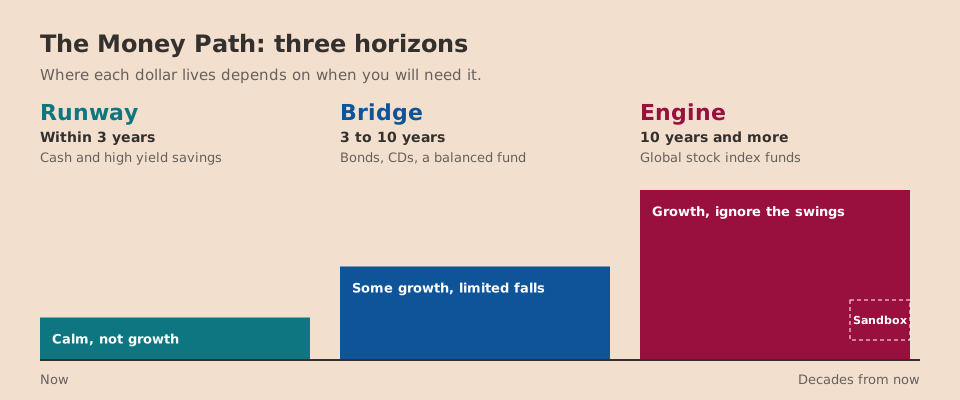
| Runway | Bridge | Engine | |
|---|---|---|---|
| When you need it | Within 3 years | In 3 to 10 years | In 10 years or more |
| Its job | Keep life running whatever happens | Pay for known goals; refill the Runway later in life | Grow, so the money lasts the life you want |
| Where it lives | FDIC insured high yield savings, money market funds, Treasury bills | Bond funds, balanced funds, CDs, I bonds, a 529 plan close to use | Broad, cheap, global stock index funds in your 401(k), IRA, HSA and brokerage |
| Expected return after inflation | About 0% | About 1 to 3% | About 4 to 7% over long periods |
| Biggest risk it protects you from | Bad luck and forced selling | Market crashes right before a goal | Running out of money |
Why three and not more? Because the date you need the money is the one thing that really matters, and three horizons cover it. Everything else, such as which account or which fund, is detail that sits inside a horizon.
And the fun money? Keep a sandbox of at most 5% of the Engine for single stocks, crypto or whatever you are curious about. It sits inside the Engine, it is allowed to fail, and its job is to keep your hands off the rest. If you do not feel the itch, skip it and earn more.
Your home and Social Security count. Home equity and future Social Security act like a Bridge: steady, inflation linked value. Counting them puts market crashes in perspective; for many households a 30% drop in stocks is a much smaller share of total wealth than it feels like.
Nine steps in order
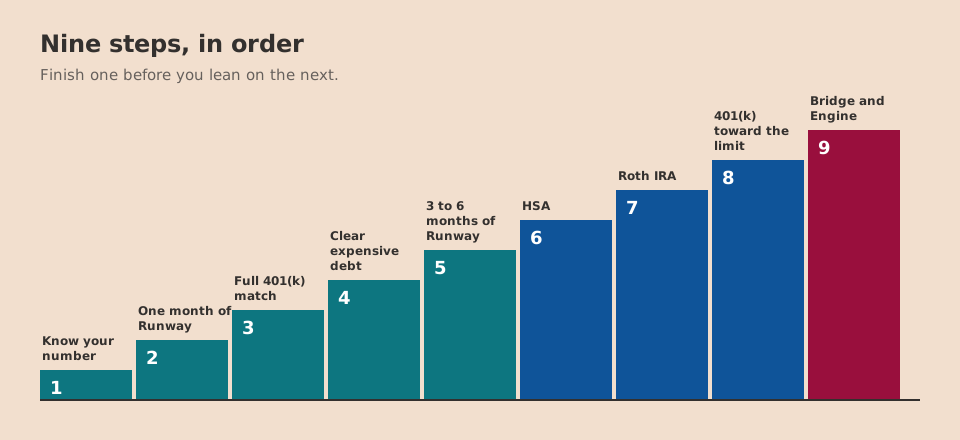
Do them in this order. Each step is finished, or running on autopilot, before the next one gets extra money. Most people are working on two steps at a time, and that is fine.
- Know your number. Add up 12 months of spending, everything included. This one figure drives your Runway, your freedom number and your savings rate.
- Starter Runway: one month of expenses in a high yield savings account, so a surprise bill does not land on a credit card.
- Take the full employer 401(k) match. It is often an instant 50% or 100% return. Nothing else beats it.
- Clear high interest debt. Credit cards, personal loans, anything above roughly 8%. Paying off a 22% card is a guaranteed 22% return.
- Full Runway: 3 to 6 months of expenses, sized with the Runway calculator. More if you own a home, have children, one income or variable pay.
- Health Savings Account to the limit, if you have a high deductible health plan. It is the only account that can be tax free going in, growing and coming out.
- Roth IRA to the annual limit, or a traditional IRA if that fits your tax bracket better. US review
- Raise your 401(k) toward the annual limit. Aim for a savings rate of 15 to 20% of gross income, counting the match.
- Fill the Bridge for known goals, then everything else to the Engine. A down payment in four years goes to the Bridge; college in eight goes to a 529; the rest goes into a taxable brokerage account in a global index fund.
Running in parallel the whole time: pay yourself first by automating every contribution on payday, and keep insurance that protects against what you cannot afford: health, disability, term life if someone depends on your income, and liability.
Five numbers
Five numbers tell you where you stand. Work them out once a year, or let the Money Path checkup do it for you.
| Number | How to work it out | Healthy range |
|---|---|---|
| 1. Savings rate | Everything you save, including the 401(k) match, divided by gross income | 15% or more; 20% or more if you started late |
| 2. Runway months | Cash savings divided by monthly expenses | 3 to 6 months while working |
| 3. Expensive debt | Total balances above about 8% interest | Zero |
| 4. Freedom ratio | Invested assets divided by your freedom number (annual expenses not covered by Social Security or a pension, times 25) | Rising every year; 100% means work is optional |
| 5. Fee drag | Average yearly cost of your funds and advice | Under 0.25% a year |
The freedom ratio is the one to watch over a lifetime. A rough guide by age, if you want one: 10% by 35, 30% by 45, 60% by 55, 100% by your planned retirement age. US review These are rules of thumb, not targets; your own number depends on when you started and what you plan to spend.
Living on your money
When you stop working, the flow reverses:
- The Runway pays the bills. Hold 2 to 3 years of the expenses Social Security does not cover, plus any big purchases you have planned.
- The Bridge refills the Runway. Once a year, top the Runway back up from the Bridge.
- The Engine refills the Bridge, but only in years when markets are up. In a crash you live on the Runway and leave the Engine alone to recover.
This protects against sequence of returns risk: two retirees with the same savings and the same average return can end up in very different places if one meets a crash in the first five years. The Runway and the Bridge buy time, so you are never forced to sell stocks at the bottom.
How much do you need? Multiply the spending Social Security and pensions do not cover by 25. That is the classic 4% rule from William Bengen's 1994 research. In 2025, Bengen updated his worst case safe rate to 4.7%; Morningstar's researchers landed on 3.7% in 2024 using forward looking assumptions. The research does not agree, and the exact multiple matters less than having a plan and staying flexible: spending a little less in bad years has historically been the biggest lever for making the money last. If most of your savings are in pre tax accounts, aim higher, closer to 30 times, to cover the tax on withdrawals. US review
Try it with the freedom number calculator.
The yearly review
Once a year, at New Year or on your birthday, spend an hour on three questions:
- Has my life changed? New job, new child, a move, a health change.
- Have my goals changed? A goal that moved closer than 10 years shifts from Engine to Bridge; one closer than 3 years shifts to Runway.
- What do the five numbers say? Update them and pick the one step to focus on this year.
Then rebalance: refill the Runway if you used it, move money between horizons as goals get closer, and if the sandbox did very well, take the profit and move it to the Engine.
Why it works
- Simple beats clever. Three horizons, nine steps, five numbers. Larger wealth does not need a larger spreadsheet.
- Automation beats willpower. In investing, the lazy, passive and logged out investor wins.
- Order beats optimization. Doing the right steps in the right order matters far more than finding the best fund.
- Measurement beats worry. Five numbers once a year replace checking your balance every day.
- Income beats returns early on. Until your investments are in six figures, a raise moves your freedom ratio more than any portfolio choice.
Sources
- Bengen, W. P. (1994). Determining Withdrawal Rates Using Historical Data. Journal of Financial Planning.
- Bengen, W. P. (2025). A Richer Retirement: Supercharging the 4% Rule to Spend More and Enjoy More.
- Morningstar (2024). The State of Retirement Income: Safe Withdrawal Rates. Christine Benz et al.
- Benz, C. The Bucket Approach to Building a Retirement Portfolio. Morningstar.
- Evensky, H. The original two bucket strategy.
- Statman, M. (2010). What Investors Really Want.
- Thaler, R. and Shefrin, H. (1981). An Economic Theory of Self Control.
- Das, S., Markowitz, H., Scheid, J. and Statman, M. (2010). Portfolio optimization with mental accounts. Journal of Financial and Quantitative Analysis, 45(2).